The Fallacy of the Center Ceiling Grid
Standard commercial developments often install symmetric grids of recessed ceiling downlights. From an architectural perspective, this induces visual glare, flattens textural surface depth, and triggers melatonin suppression by casting downward high-kelvin illumination onto retinas late into the evening.
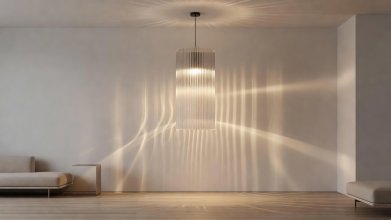 Optical Fluting
Fluted & Slumped Glass
Vertical linear ridges break intense bulb points into broad, striated bands of illumination, creating soft atmospheric highlights.
 Loom Filtration
Raw Linen Shades
The natural slub of unbleached flax filters harsh solar beams into an organic, amber-tinted ambient wash.
Circadian 24-Hour Luminaire Schedule
Our studio implements a tri-phase residential schedule to sync ambient domestic light with the solar curve:
| Time Window | Color Temp (Kelvin) | Lux Level | Primary Light Source |
|---|---|---|---|
| 07:00 – 11:00 (Dawn Ingress) | 4000K – 5000K | 400 – 600 Lux | Natural solar window ingress modulated by sheer flax |
| 12:00 – 17:00 (Active Noon) | 3000K – 3500K | 300 – 450 Lux | Diffused architectural perimeter coving and task spots |
| 18:00 – 23:00 (Nocturne Retreat) | 2200K – 2700K | 50 – 120 Lux | Floor-level indirect uplights, ceramic table sconces |
Wall Grazing & Texture Amplification
When light is placed parallel and close to a textured wall—such as lime plaster or split-face travertine—it creates dramatic micro-shadows. This grazing technique transforms static walls into dynamic tactile canvases without requiring wall art or superficial decor.
Complementary Material Study
Light is only as compelling as the physical materials that catch and reflect it.
Review Material Palettes